ANSYS LUMERICAL / FDTD

Lumerical RCWA: diffraction efficiency of periodic structures, computed fast

Rigorous coupled-wave analysis returns the diffraction efficiency of periodic microstructures by wavelength, angle and polarisation. Because periodicity can be assumed, it is orders of magnitude faster than solving the same problem with FDTD.
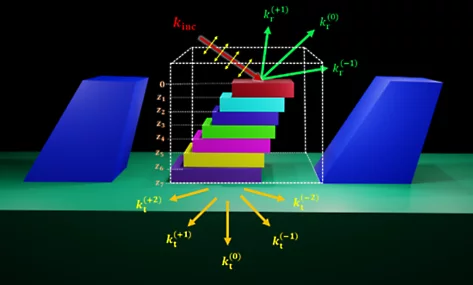
RCWAMeta-atomsDiffraction gratings

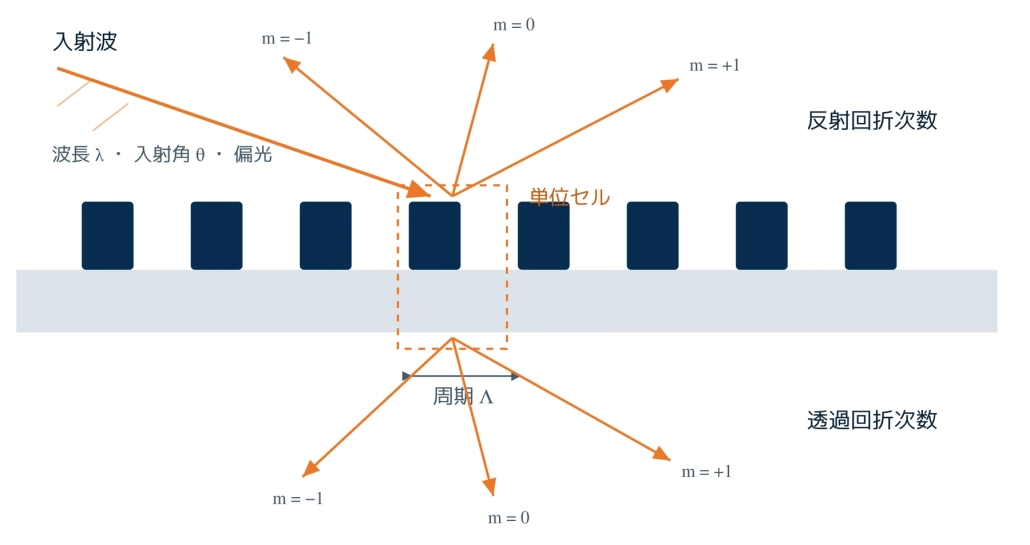
Schematic of an RCWA analysis, showing the wave incident on a periodic multilayer structure and the wavevectors of the reflected and transmitted diffraction orders

Overview

A rigorous solver that assumes periodicity

The periodicity of the structure is used to expand the electromagnetic field into a Fourier series, and the coupled-wave equations are solved layer by layer. Because no time evolution is followed, a solution for a single wavelength and angle is obtained quickly.

Designing a metasurface requires sweeping the dimensions of the meta-atom to establish how phase and transmittance vary with them. Whether that sweep can be run in a realistic time is what determines how the design work proceeds.

Because periodic boundaries are assumed, finite-size effects and local defects cannot be treated. Verifying the structure as a whole requires another method alongside it.

The periodic structure treated by rigorous coupled-wave analysis (RCWA), and its unit cell

Defining the periodic structure and the unit cell

Diagram of the RCWA principle: an incident wave enters a periodic structure (unit cell, period Λ), producing diffraction orders m = −1, 0, +1 on the reflected and transmitted sides

Schematic: incident wave → periodic structure (unit cell) → diffraction orders

The advantages of RCWA

What assuming periodicity buys you

01

Fast

Sweeps of hundreds to thousands of conditions can be run in a realistic time.

02

Angle and polarisation

The response can be obtained directly for each angle of incidence and polarisation.

03

Library generation

Building a meta-atom library is one of the classic uses of RCWA.

Phase and transmittance as functions of the dimensional parameters, from an RCWA sweep

Phase and transmittance obtained from a dimensional sweep

Where it fits

Where it fits, and where it does not

There are cases another method will solve faster and more accurately. The following is a guide to choosing.

Use RCWA

  • The structure is periodic, or a periodic approximation is reasonable
  • You want diffraction efficiency order by order
  • You need to sweep many dimensional conditions
  • You want to generate a meta-atom library
  • You are working with a multilayer periodic structure

Consider another method

  • Finite-size structures, or structures containing defects → FDTD
  • Arbitrary shapes with no periodicity → FDTD
  • Flat multilayer films only → STACK
  • Waveguide modes → MODE
Phase and transmittance from FDTD and from RCWA, compared for the same periodic structure

FDTD and RCWA compared on the same structure. Where the periodic approximation holds, the two agree.

Typical applications

Where it is used

Meta-atom radius against phase — a library for metalens design

Metalenses and metasurfaces

Generating phase and transmittance libraries for meta-atoms

View the solution

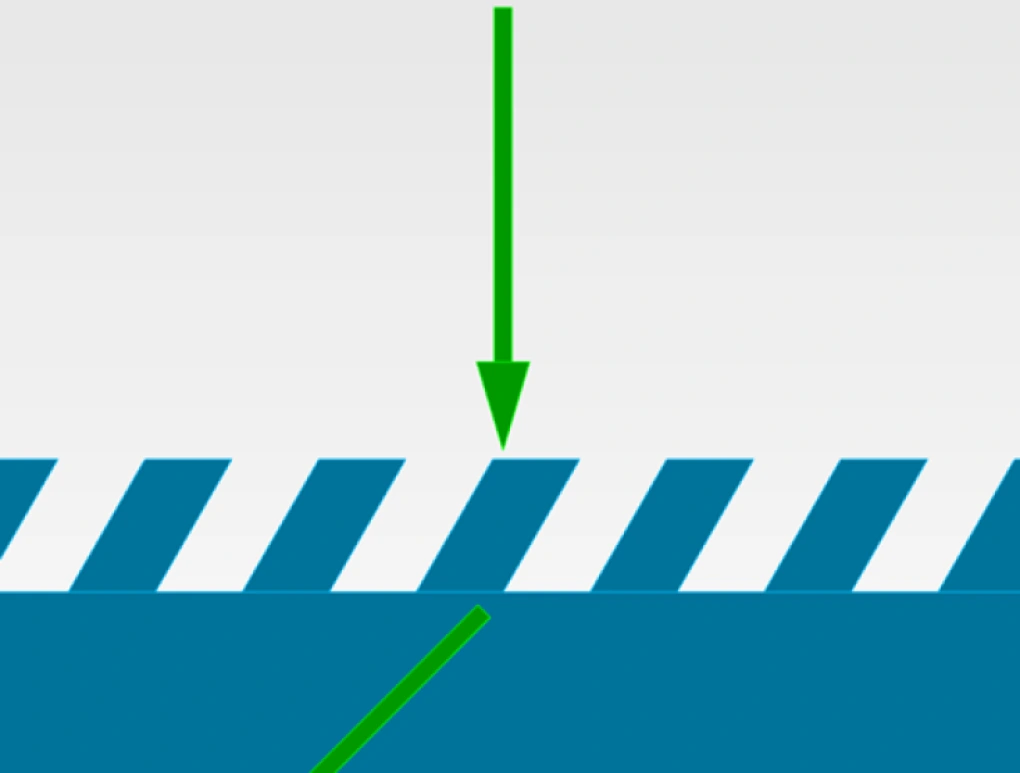
RCWA model of a surface-relief diffraction grating for AR/VR, showing the slanted grating together with the incident light and the light diffracted into the substrate

AR/VR lightguides

How grating efficiency depends on angle and wavelength

View the solution

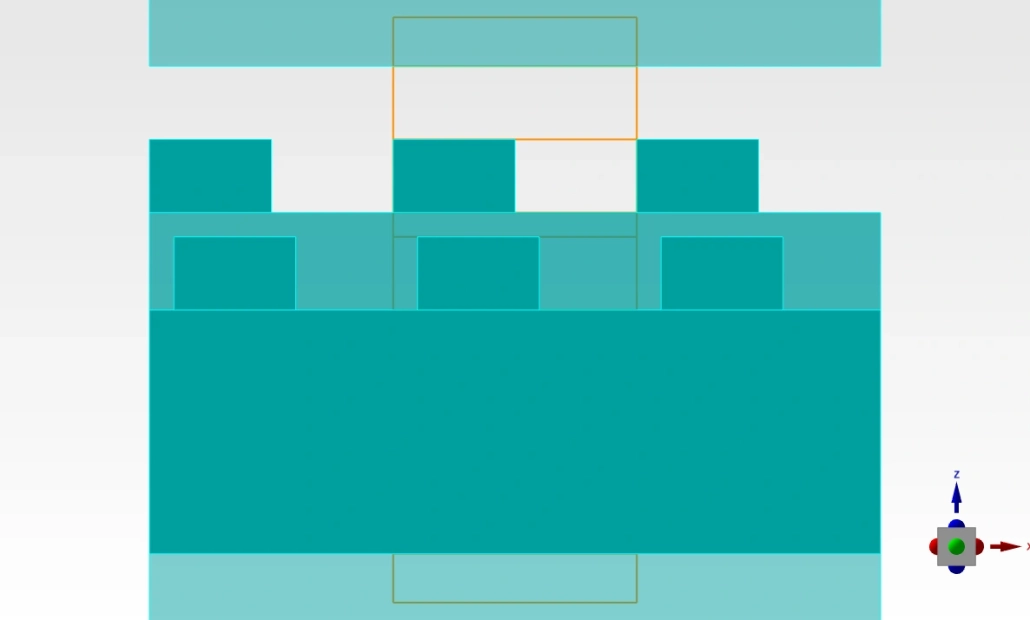
Cross-section of a diffraction-based overlay metrology target, showing the stacked grating structure and the unit cell region used in the RCWA analysis

Semiconductor metrology and diffraction gratings

Evaluating the diffraction signal and the grating profile of overlay metrology targets

View the solution

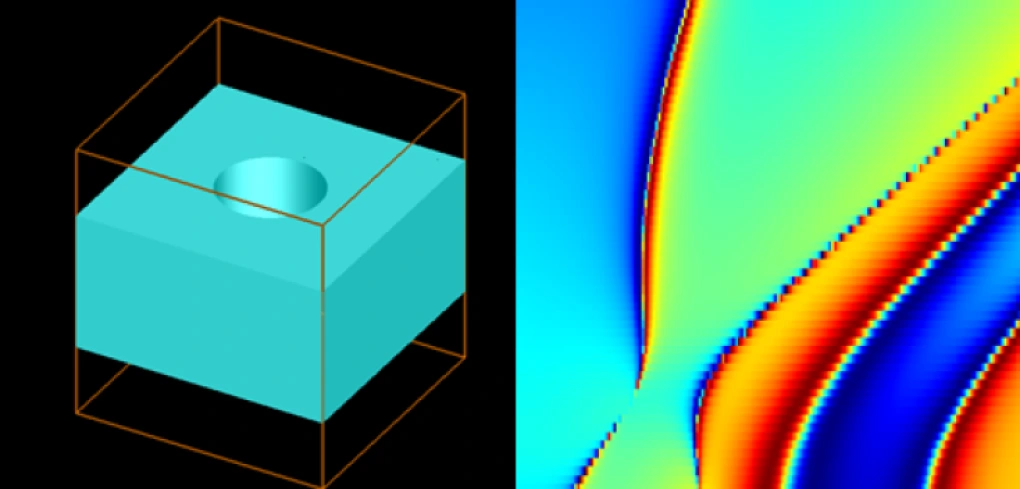
RCWA analysis of a photonic crystal slab, showing the unit cell of the perforated periodic slab and the response across frequency and angle

Photonic crystals

Evaluating the reflection and transmission spectra of a periodic slab

View the solution

Inputs and outputs

What you supply, and what you get back

For the incidence conditions and structure you set, the response is returned order by order.

INPUT

What you need to prepare

Unit structureThe geometry and materials within the periodic cell
PeriodPitch in x and y
Incidence conditionsWavelength, angle of incidence, azimuthal angle, polarisation
Expansion ordersThe Fourier orders. Convergence needs to be checked

RCWA

Rigorous coupled-wave analysis

OUTPUT

What you get back

Diffraction efficiencyTransmittance and reflectance for each order
PhaseComplex amplitude and phase for each order
SpectraThe response across a wavelength sweep
LibraryA table of phase and transmittance against dimensions

Frequently asked questions

Questions we are often asked about RCWA

The questions we are most often asked before adoption.

If the structure is periodic and you want diffraction efficiency, use RCWA. For finite-size structures, or arbitrary shapes with no periodicity, use FDTD. In metasurface design it is common to use both: build the library with RCWA, then verify locally with FDTD.

Raise the order until the result stops changing. The higher the index contrast of the structure, the more orders are needed.

Fix the material, wavelength, pitch and height, then sweep dimensional parameters such as the radius and record the phase and transmittance. In Photonica this can be handled as a connected RCWA workflow.

Yes. You can specify the angle of incidence and the azimuthal angle and evaluate the angular dependence.

Japanese-language support and training

We can advise on everything from analysis setup to judging whether a result is sound. Hands-on training, where you work with the software yourself, is also available.

Things it helps us to know before we talk

  • The wavelengths and materials involved
  • The device structure and its approximate dimensions
  • The characteristics you want to evaluate, and your target values
  • Whether you have existing analysis data or measurement results
  • The schedule you have in mind

It is fine if there is information you cannot share — tell us only what you are comfortable with.

Try it on the structure you actually want to solve

The demo is built around a structure close to your own. We can also give you an indication of the problem size and the run time on the spot.