Home/Technical Information/Design and Simulation Guides

Technical Information

Design and Simulation Guides

From basic product operation and analysis setup to practical design and analysis workflows, these explain the steps and the points that matter in real work.

All articles

All design and simulation guides

Guide articles covering basic operation, analysis setup and practical workflows.

Schematic of light incident on a metalens propagating as several outgoing rays and forming a focal spot in the far field

Large-Scale Metalens: Ray Propagation

A practical workflow for designing and analysing centimetre-scale metalenses across Lumerical and Zemax OpticStudio: building a meta-atom database with RCWA, exchanging data through HDF5, ray tracing, and exporting GDS.
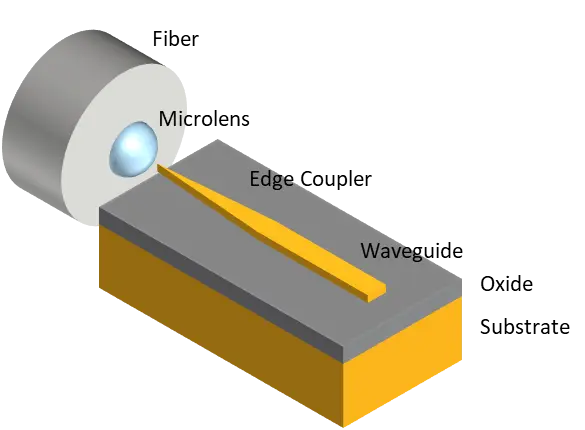
Fiber to Photonic Chip coupling with a microlens

Coupling Fibre to a Photonic Chip: a Microlens and Edge Coupler Approach

How to design coupling from an optical fibre into a photonic chip using a microlens and an edge coupler: fibre mode analysis in Lumerical MODE, alignment evaluation with POP in OpticStudio, and analysis of the coupling region with FDTD and EME.
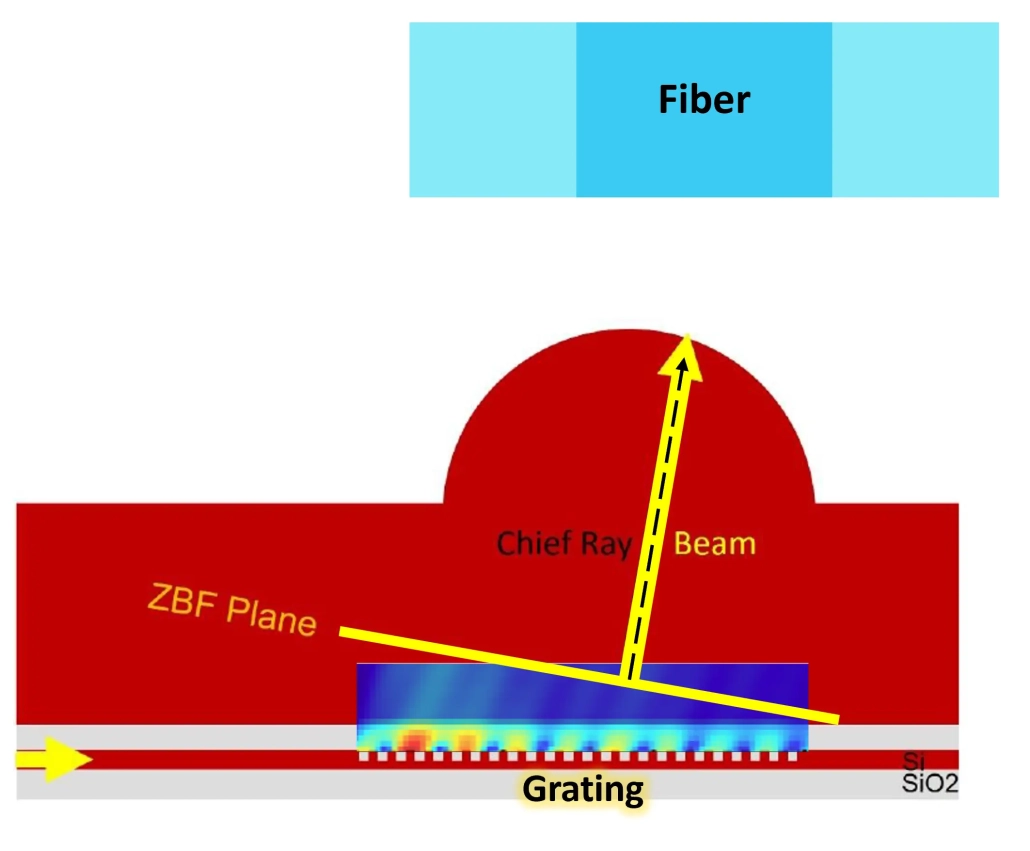
Schematic of a coupling simulation between a grating coupler and an optical fibre

Improving Optical Coupling Efficiency in Photonic Integrated Circuits: Co-Designing a Microlens and Grating Coupler

How to raise fibre-to-waveguide coupling efficiency by co-designing a grating coupler and a microlens. Fields solved in Lumerical FDTD are passed to Zemax OpticStudio as ZBF, where POP is used to evaluate lens curvature and placement in a multi-scale analysis.
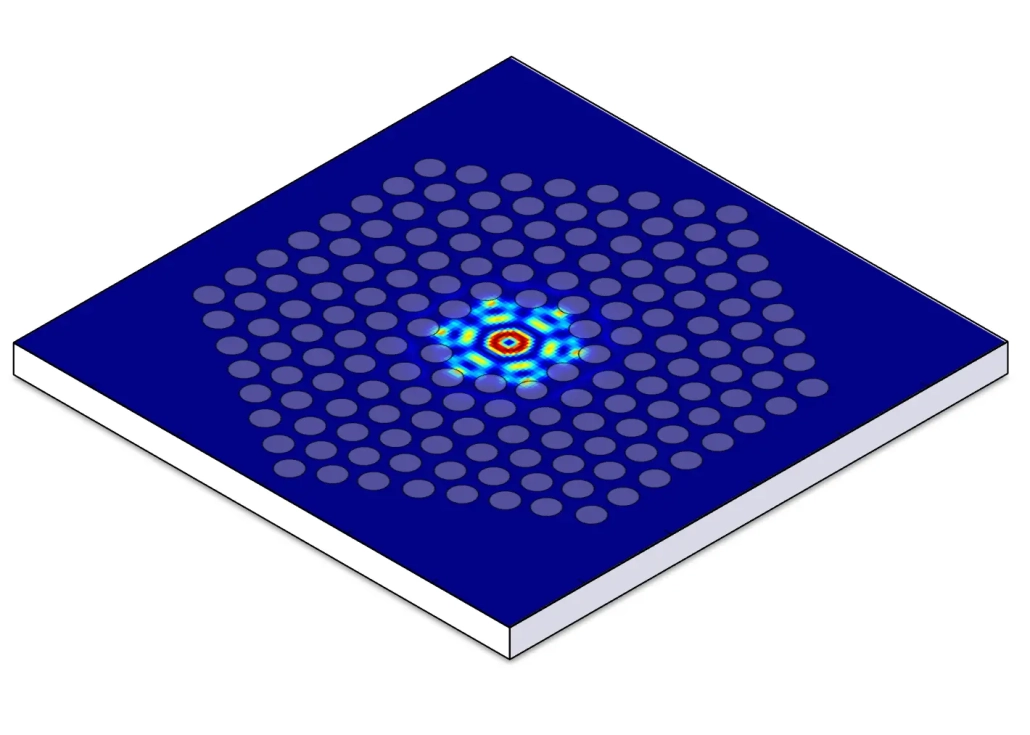
FDTD simulation model of a photonic crystal nanocavity, showing the lattice and the cavity defect

Designing and Analysing Photonic Crystal Nanocavities (FDTD / varFDTD)

How to reproduce and verify the design and analysis of H1 and H2 photonic crystal nanocavities in Lumerical FDTD and MODE varFDTD, covering resonance spectra, symmetric boundary conditions, mode profiles, mesh settings and Q-factor evaluation.
Cross-section of a scattering simulation of gold posts on a DVD surface (Lumerical FDTD)

Scattering from Small Particles and Surfaces

A full three-dimensional model in Lumerical FDTD of a focused beam interacting with gold posts on a DVD disc surface. Near-field images and far-field radiation patterns are compared with and without the post, and a dimension sweep finds the smallest gold post that still gives a usable modulation signal.
Workflow diagram for using Lumerical together with Zemax OpticStudio: beam propagation, mode analysis and coupling evaluation

Linking Lumerical and Zemax OpticStudio in Optical Design

A practical guide to working across Lumerical and Zemax OpticStudio: ZBF file exchange, FDE mode analysis, overlap analysis and improving fibre coupling efficiency, with the settings that matter at each step.
Metalens design

Metalens Design Across Lumerical and Zemax: Design Flow and Validation Guide

The design flow for a diffractive metalens built from cylindrical nanorods, worked across Ansys Lumerical and Zemax OpticStudio: building a phase library from unit-cell analysis (FDTD and RCWA), full-lens analysis by field reconstruction, system-level evaluation with POP, and GDS export.
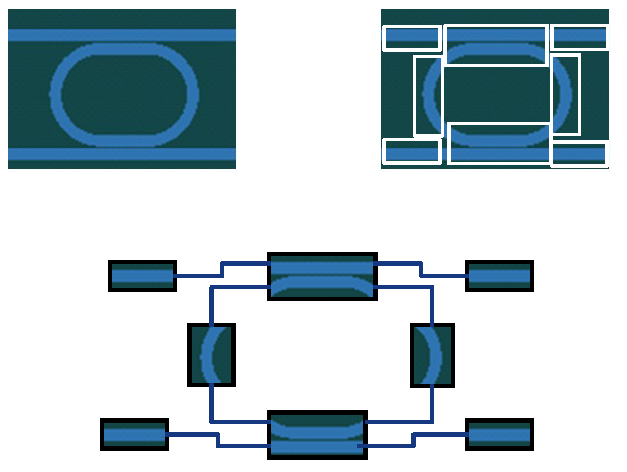
Comparison of ring resonator simulation methods: moving from a full FDTD solve to a partitioned workflow that separates the coupler and the waveguide and reassembles them in INTERCONNECT

Analysing Large Ring Resonators: the Limits of a Full Solve and a Partitioned Approach

A large-radius ring resonator is prohibitively expensive to solve in full with FDTD. This article sets out where varFDTD helps and where it stops helping, then walks through a partitioned approach: S-parameters for the coupler from FDTD, the bend from FDE, and the whole thing reassembled as a circuit in INTERCONNECT.
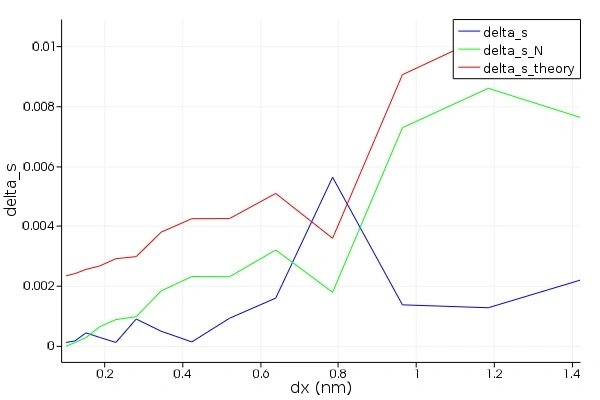
Graph of mesh size (dx) against analysis error in a Lumerical FDTD convergence test

Troubleshooting Lumerical FDTD Accuracy: Settings That Prevent Wrong Results

What to do when an FDTD solve returns something impossible, such as transmission above one. Covers rechecking the basic settings, isolating the cause by simplifying the model in stages, visualising the fields, revisiting material fitting, and confirming with a convergence test.
Lumerical Mesh

Key Settings in an Ansys Lumerical FDTD Simulation

A checklist of the Ansys Lumerical FDTD settings that are easiest to overlook: mesh size and mesh order, material fitting, simulation time and span, boundary conditions and source span, with what to check and why each setting is what it is.
Integrated photonic and fibre components

FDTD Compared with EME

PIC device design always involves a trade-off between accuracy and compute time. This article compares the principle and scope of FDTD and EME and, using a grating coupler and a tapered spot-size converter as examples, shows how to choose between the solvers on the basis of measured cost and accuracy.

Struggling to build a design workflow, or to optimize analysis accuracy?

Our engineers can advise on building a design flow for your application and on assessing the validity of an analysis model, grounded in real practice.