
Home/Products/Ansys Lumerical/Lumerical Multiphysics

ANSYS LUMERICAL

Lumerical Multiphysics:
optical, electrical, thermal and quantum well analysis in one environment

DGTD and FEEM for optics, CHARGE for electrical behavior, HEAT for thermal behavior and MQW for quantum wells, brought together in one product. A shared Multiphysics design environment and material database let you handle the physics that interacts inside a device.
DGTDFEEMCHARGEHEATMQW

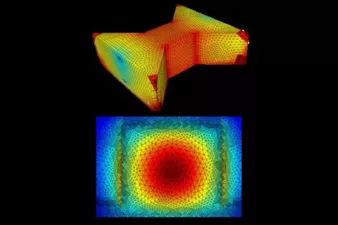
Lumerical Multiphysics analysis example, showing a three-dimensional structure on a finite-element mesh with the mode profile of its cross-section

Overview

Interacting physics, in one environment

The characteristics of a photonic device are rarely set by one physical effect alone. Injected carriers change the refractive index, absorbed light raises the temperature, and that temperature moves the index again. Estimate each separately and add them up by hand and the interaction between them is lost.

Lumerical Multiphysics includes optical solvers. DGTD is an electromagnetic solver that solves Maxwell’s equations in the time domain; FEEM is a mode solver that finds the eigenmodes of a waveguide cross-section. These are joined by CHARGE for electrical behavior, HEAT for thermal behavior and MQW for quantum wells.

A shared Multiphysics design environment and material database let you combine the solvers you need into an analysis workflow. Analyzing a diffraction grating with DGTD while working on a thermo-optic phase shift with HEAT and FEEM is one such arrangement.

01

Optical solvers included

Electromagnetic analysis with DGTD and mode analysis with FEEM are part of the product.

02

Self-consistent electrical and thermal coupling

Set the temperature dependence in CHARGE to COUPLED and the drift-diffusion and heat conduction equations are solved self-consistently.

03

A shared Multiphysics design environment

A shared design environment and material database let you combine whichever solvers you need.

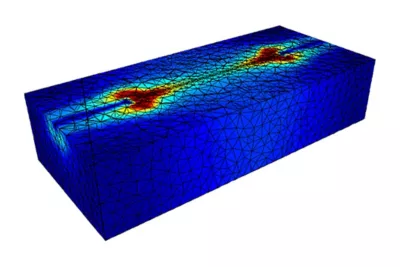
Example electrical and thermal analysis results, showing regions of high carrier density and high temperature distributed over a three-dimensional mesh

Solvers

The five solvers in Multiphysics

Two of them, DGTD and FEEM, are optical solvers. The setup and theory of each solver are covered on the Analysis Technologies pages.

DGTD

Electromagnetic. Solves Maxwell’s equations by the discontinuous Galerkin time-domain method. Its unstructured mesh suits curved surfaces and metallic nanostructures.

FEEM

Modes. Finds the eigenmodes of a waveguide cross-section by the finite-element method.

CHARGE

Electrical. Solves the Poisson and drift-diffusion equations. Steady-state, small-signal AC and transient are supported.

HEAT

Analyzes steady-state and transient heat transport to obtain the temperature distribution. In electrical-thermal coupling, Joule heating can also be taken into account.

MQW

Analyzes the band structure of a multiple quantum well by the k.p method to obtain optical properties such as gain and spontaneous emission spectra.

The VCSEL Design Tool (beta) couples CHARGE, HEAT and MQW to analyze VCSELs. Using it requires an Ansys Lumerical Enterprise license and activation of the feature.

Typical workflows

Four common analysis flows

Each is built around the Multiphysics solvers. The setup and theory of the individual solvers are covered on the Analysis Technologies pages.

Electro-optic modulation

CHARGEMODE (FDE) / FEEM

Obtains the optical response to applied voltage: the change in effective index, and loss.

Thermo-optic phase shift

HEATFEEM / MODE (FDE)

Obtains the phase shift and loss from the temperature distribution, and the power required.

Photodetectors

FDTD / DGTDCHARGE

Passes across the optical generation rate obtained from absorption, and obtains photocurrent: responsivity, dark current and bandwidth.

Lasers and SOAs

MQW + FEEM / MODE (FDE)INTERCONNECT

Passes gain spectra and mode information to a TWLM element for evaluation at circuit and system level.

Coupling

What passes between the solvers

The handover mechanisms are provided, but the order of execution is the designer’s to decide. Optical results pass to the electrical and thermal side, and electrical and thermal results pass back to the optical side.

FromToWhat passes across, and how
FDTD / DGTDCHARGEOptical generation rate, brought in as Import optical generation
FDTD / DGTDHEATAbsorbed optical power, used as thermal input via Import heat source
CHARGEFDTD / MODECarrier density, brought in as an np Density grid attribute to obtain the change in the real and imaginary parts of the refractive index
HEATFDTD / MODETemperature distribution, brought in as a Temperature grid attribute
HEATFEEMTemperature distribution, converted to an index change by script and brought in as an (n,k) material
CHARGE ↔ HEATWithin the same analysisWith temperature dependence set to COUPLED, the drift-diffusion and heat conduction equations are solved self-consistently
CHARGEMQWElectric field, carrier density and temperature. Specify MQW domains on the CHARGE side and gain and absorption spectra are computed for every bias in one pass
MQWINTERCONNECTGain and spontaneous emission spectra, as input to a TWLM element
FEEM / MODE (FDE)INTERCONNECTEffective index, group index and confinement factor, as input to a TWLM element

Related products

Ansys Lumerical products used alongside it

Multiphysics includes optical analysis with DGTD and FEEM. For broadband 3D propagation analysis, propagation analysis of waveguides and planar circuits, and circuit-level verification, it is used together with the following products.

FDTD

Broadband 3D electromagnetic analysis by the finite-difference time-domain method. The RCWA and STACK solvers are included with it.

MODE

FDE, varFDTD and EME. Waveguide modes and propagation analysis of planar circuits.

INTERCONNECT

Circuit and system simulation of photonic integrated circuits. Solves by combining compact models such as TWLM.

Frequently asked questions

Questions we are often asked about Lumerical Multiphysics

That depends on the problem. 3D electromagnetic analysis of diffraction gratings, scatterers and the like can be run in Multiphysics with DGTD, and mode analysis of a waveguide cross-section with FEEM. On the other hand, extracting S-parameters for components whose inputs and outputs are waveguide modes, or propagation analysis of waveguides and planar circuits, is better done with FDTD or MODE alongside it.

Ansys Lumerical Multiphysics contains five solvers: DGTD, FEEM, CHARGE, HEAT and MQW. There is no standalone product for CHARGE or HEAT. FDTD and MODE are separate products. Tell us what you need to evaluate and we will propose the combination of products required.

CHARGE and HEAT can be coupled self-consistently by setting the temperature dependence to COUPLED. Integration with FDTD, MODE and others, and one-way data handover, are arranged by exporting and importing results or by script. Where iteration is needed, it can be automated.

Yes. Alongside the Lumerical script language, a Python API (lumapi) and a MATLAB API are available. PyLumerical is also provided.

Japanese-language support and training

We can advise on everything from analysis setup to judging whether a result is sound.

Support →

Training →

Helpful to know before we talk

  • Target wavelengths and materials
  • Device structure and approximate dimensions
  • The characteristics you want to evaluate, and your target values
  • Whether you already have simulation data or measurements
  • Your expected schedule

You do not need to share everything. Whatever you are able to tell us is enough.

Let us design the analysis flow with you

Tell us the device structure and the characteristics you need to evaluate, and we will propose which workflow to use, with which solvers, in which order.